Traveling around Syria is like taking a (fun) History class. Actually it is more of a combination of History, Art and even Religion.
A couple weekends ago my friend Mona and I had the chance to visit Bosra, a town 100 miles south of Damascus, near the border with Jordan. I had heard wonderful things about it and I must admit I was worried about being disappointed. The main attraction of Bosra is its Roman amphitheater, and I have seen so many already….. However, Bosra definitely is special. Take my word for it, this place is amazing.
As usual in Syria location was key to the development and success of this city. It existed already in the 14th century before Christ, but it was probably only 20 centuries ago when it flourished the most due to the construction of a mayor road that linked Damascus with Amman (Jordan’s capital). This road is actually quite different that the one that goes to Palmyra. You actually see vegetation here, plenty of it. There are plantations nearby the road, and there are dozens of stalls selling all kinds of fresh fruits and vegetables.
Another difference between Palmyra and Bosra is the color of the stone used to build each city. While Palmyra is very light, almost the same color as the sand of the desert, Bosra is made of a much darker stone, almost black. The city was built by the Romans following their traditional grid design, but all that remains of the city are ruins, except for the amphitheater, but I will talk about it later on.
Like I said before, Syria is a lesson of Religion, and as such Bosra has taught me a few interesting things. One of them is that the city was an important stop for religious and commercial caravans that would travel around the region and to the two holy cities of Islam: Mecca and Medina. As such, Mohamed, the Prophet, stopped in this city when he was 12 during a trip with his merchant uncle. In fact one of the oldest mosques in the world is built here, in the place where Mohamed’s camel knelt. But the most significant event that happened here is that apparently it was here that his future was revealed to him: a local priest, Bahira, was having a theological discussion with Mohamed when he announced to him his future vocation as a Prophet.
Bosra also hosts the ruins of what was one of the largest Cathedrals in the region, a masterpiece of Christianity because it was one of the first buildings that combined a square base with a round dome, back in the 6th century. There isn’t much left of it.
Going back to the amphitheater, main reason for my trip, it is said to be the best preserved in the whole wide world. And it seems true, at least to a non expert such as me. Like I said before, I was afraid this place wouldn’t really impress me too much, come on, I have seen so many Roman ruins before that I am almost bored of them. OMG, seriously, you cannot imagine how magnificent the place is. Above all, you need to understand these are not ruins. The amphitheater is still used for concerts and there is even an annual festival that takes place in it.
As soon as I walked into the stands I felt like I had traveled back in time to the 2nd century, when it was built. I felt like a spectator about to watch some ancient drama, or gladiators. I felt like an artist about to perform, like a choreographer in the backstage following the moves of my artists... It is impossible to describe with words what it felt like, but it was grandiose, dramatic, impressive.
To give you an idea the place could sit 15,000 people, the city had no more than 80,000 citizens. Thus one out of 5 citizens could attend a show at the same time. Imagine a theater in New York City that could host 1.7 millions spectators at once. Amazing.
I wish these pictures could illustrate better the magnificence and splendor of this place, perhaps you will have to visit it yourself to understand it.
Showing posts with label Syria. Show all posts
Friday, November 5, 2010
Tuesday, October 26, 2010
Palmyra, the bride of the desert
A couple of weeks ago I woke up early on a Saturday and drove to Palmyra, supposedly some of the most amazing ruins in the world. I had high expectations and I was scarred to actually be disappointed. I wasn’t. It is probably one of the most breathtaking places I have ever visited.
In the middle of the desert, surrounded by an oasis of palm trees, hide the ruins of this ancient city called Palmyra. At first it seems like 50 hectares of sand and columns, but it is so much more: an amphitheater, the Bel temple, funerary towers… a journey to an ancient civilization.
There are records of Palmyra that date from the second millennium bC and the Hebrew bible explains the city was founded by King Salomon, son of David. Its unique and exceptional location made of Palmyra an important stop in the Silk Road, between China and Europe, the Mediterranean and the Middle East.
But it wasn’t really until the third century of our era that Palmyra reached its greatest splendor, under the leadership of queen Zenobia. Zenobia was descendant of Cleopatra, and she is said to be more beautiful, smarter and also more ambitious than the Egyptian queen. Zenobia’s reign was short but intense and in only six years she expanded the boundaries of the city, built temples and erected statues. Most importantly, she conquered territories around hers and got to dominate lands all the way to Western Egypt. She even had the guts to stand up against the Roman Empire and succeeded at it. However, this was also a breaking point in Palmyra’s history, and the beginning of its end. Zenobia ended up captive and it is said that she was taken to Rome where she was exhibited half naked with golden chains around her body.
But Zenobia’s legacy is undeniable. She made of Palmyra an empire, rich and developed, which had its own language and art. The golden limestone of surrounding mountains is a symbol of that time, and hundreds of columns are silent witnesses of everything that has happened here ever since.
Honestly, visiting Palmyra is a unique experience. While you walk through the kilometer long colonnade you suddenly travel in time, you find yourself far in the past, surrounded by a combination of cultures. After the Romans came the Arabs, and the Ottoman Empire was the one that witnessed the fall into decline of this once great city.
An example of the blend of cultures is the temple of Bel. It is half destroyed but it still has a feeling of what it must have been back in the time. It was at first a temple dedicated to the god Bel (the equivalent of the Greek Zeus or Roman Jupiter), it became a church in Byzantine times, a fortress with the Arabs and a mosque with the Mamelucs.
A bit further away hide camouflaged in the colors of the desert the funerary towers that used to belong to the rich families of Palmyra. They are quite tall and simple buildings, which could host several buried bodies. It is the Valley of the tombs.
But truth is the ruins are so big and they take so much space that it is only possible to gaze at them and admire them from one spot: the Qalaat Ibn Maan, an Arab castle built on the top on a nearby mountain in the 16th century. These are pictures taken from this fantastic viewpoint of the stunning views. (you can clik on the image to see it larger)
* All pictures taken by la elfa
Labels:
bel temple,
desert,
funerary towers,
palmyra,
ruins,
Syria,
zenobia
Monday, September 27, 2010
Deir Mar Mussa, gate to the desert
The monastery of Deir Mar Mussa is located 50 miles away from Damascus, a third of the road is through the desert. I can tell you the landscape is stunning, because the desert never ever disappoints you. If there is one awesome thing about it, it’s that it is in constant change, it is always different from the previous day and from the following one. You will never find the same scenery twice in the desert.
As you approach the valley where the monastery hides you can’t really see much, other than an orange mountain. Once you go around it, on the other side of it, you suddenly discover two tiny buildings on top of the mountain. These are the monastery and the chapel.
.JPG)
But to reach them you need to climb 344 steps literally carved in the mountain itself. In a hot day such as when I visited it (around 120F) the ascension is tough, but my motivational technique was to assume that it would be much harsher to do it in the winter with snow on the steps.
.JPG)
The whole valley and surrounding areas have been inhabited since prehistory by hunters and shepherds. Christian hermits have used the neighboring caves for meditation for centuries, and this is actually how the first monastic center was created.
Actually, legend has it that the founder of this place was actually Saint Moses, son of an Ethiopian king. Saint Moses wasn’t interested in inheriting his father’s crown or the honors that came with it, and decided to give himself to God. He emigrated to Egypt, then to Holy Land, and he ended up in Syria as a hermit in the valley of what is today the monastery.
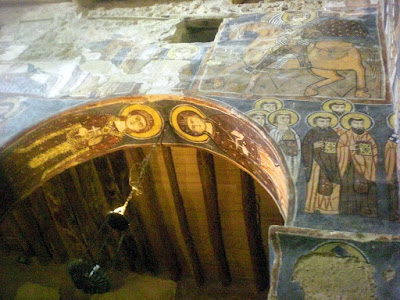
In 1058 the tiny church (30ft x 30ft) was built. Today we can still admire gorgeous frescoes dating from the 11th and 12th centuries. Later on the monastery was built.
.JPG)
Sadly the place was abandoned in the 19th century, but in the 20th it was decided to both renovate it, and to start using the complex again. The monastery is today inhabited by monks and thus cannot be visited; however the church is open for several daily masses. Nevertheless it admits non-Christian visitors as the centre strongly promotes and encourages Islamic-Christian dialogue.
Getting to the top of the mountain is definitely difficult and it requires a big effort, but the views from the balcony next to the small chapel, as well as the frescoes in it, are worth the effort of climbing every single step.
* All pictures by laelfa
Labels:
Damascus,
deir mar mussa,
frescoes,
monastery,
Syria,
the desert
Wednesday, September 1, 2010
Magnificent Krak des Chevaliers
Last weekend I had a chance to do a couple day-long trips not too far fway from Damascus with another Spanish girl who was brave enough to drive on the Syrian highways. I have now myself driven here and I realize it is not nearly as scary as I expected at first, but still the traffic of downtown Damascus in peak time freaks me out.
Anyways, going back to my weekend, I visited a magnificent castle (actually it is a fortress), and this is coming from a Spaniard that has visited many castles in Spain, France, and many other countries.
The Krak des Chevaliers (Fortress of the Knights) is a Crusader fortress located in a key spot: on top of a high hill, very close to the Mediterranean, near the border of Lebanon. From up here the crusaders could keep an eye on the road of the Mediterranean, on the lake Homs, as well as on their rivals the Muslim armies.
It was built a long time ago, in 1031, and still today it remains pretty much intact. The first crusaders arrived to it at the end of the 11th century during the First Crusade, but they soon abandoned it to continue their way towards Jerusalem. Then came the Hospitaller Knights, who rebuilt much of it and even expanded it. It is believed that up to 2,000 men lived here at some point, where they could host about 1,000 horses. Storage facilities were so big that it is said they could have withstood a siege for five years!
Today the Krak des Chevaliers is considered a model of perfection of medieval fortification and the greatest fortress in the world. It was actually never conquered and it took one smart man to be able to kick the crusaders out. His name was Baibars and after trying to conquer the place unsuccessfully, like many others before, he decided to trick the inhabitants of the Krak. He forged a letter from the crusader commander, asking the defenders to surrender. They knights were so naive that they actually gave in, and this was the only way the castle ever fell.
But in fact what I wanted to share with you is how beautiful and magnificent this place is. To me it represents what we all dreamt of as kids, especially boys when they dream of being knights, girls dreaming they are princesses.
Even TE Lawrence of Arabia described it as “perhaps the best preserved and most wholly admirable castle in the world”.
* All pictures by la elfa except the 1st one
Labels:
castle,
fortress,
homs,
knights,
krak des chevaliers,
magnificent,
mediterranean,
Syria,
tartous
Subscribe to:
Posts (Atom)
.jpg)